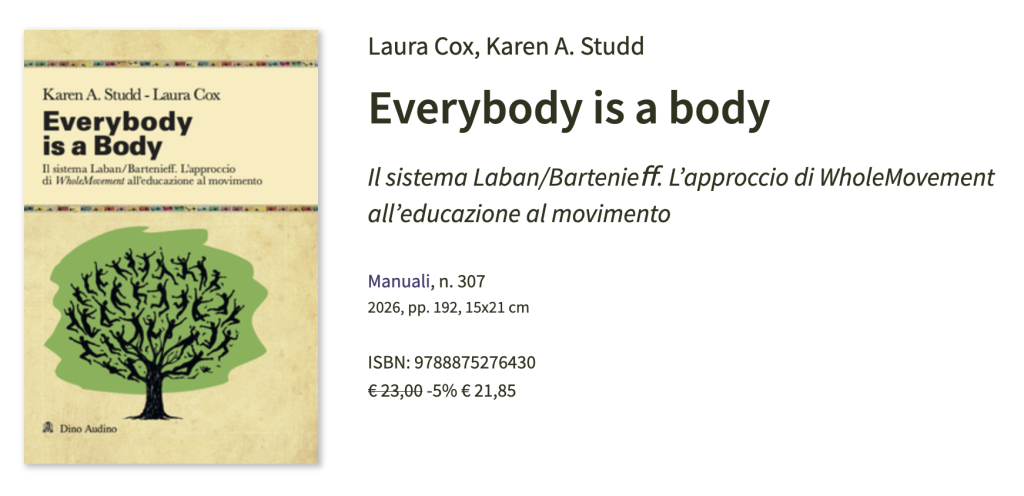
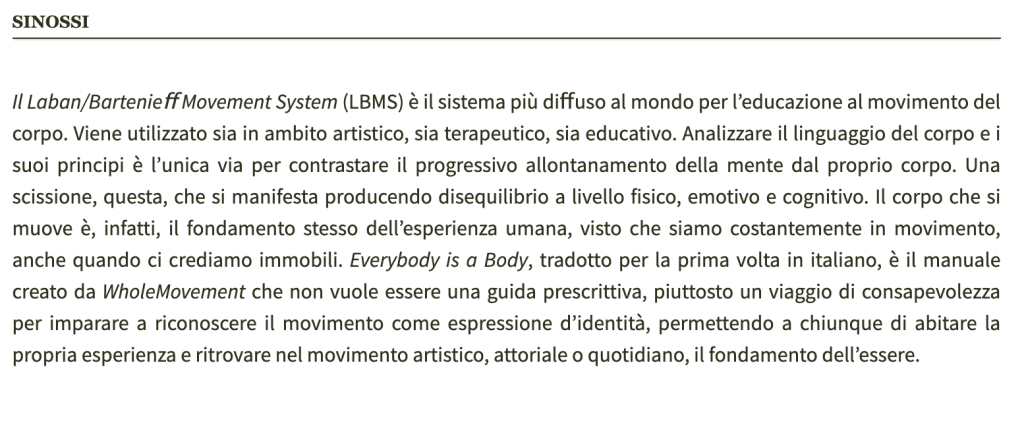
We are delighted to announce that the Italian edition of Everybody Is A Body has been published by Dino Audino, translated by Caterina Mocciola. Laura Cox had especially wanted to see the book available in Italian. We thank everyone involved in this translation for their effort and care in making this happen.
During the Pandemic years, Ali Baybutt filmed online classes introducing different concepts from the Laban/Bartenieff Movement System. These classes are slowly being shared online for free. They’re useful for personal practice and for getting a taste of somatic movement education through the Laban/Bartenieff lens.
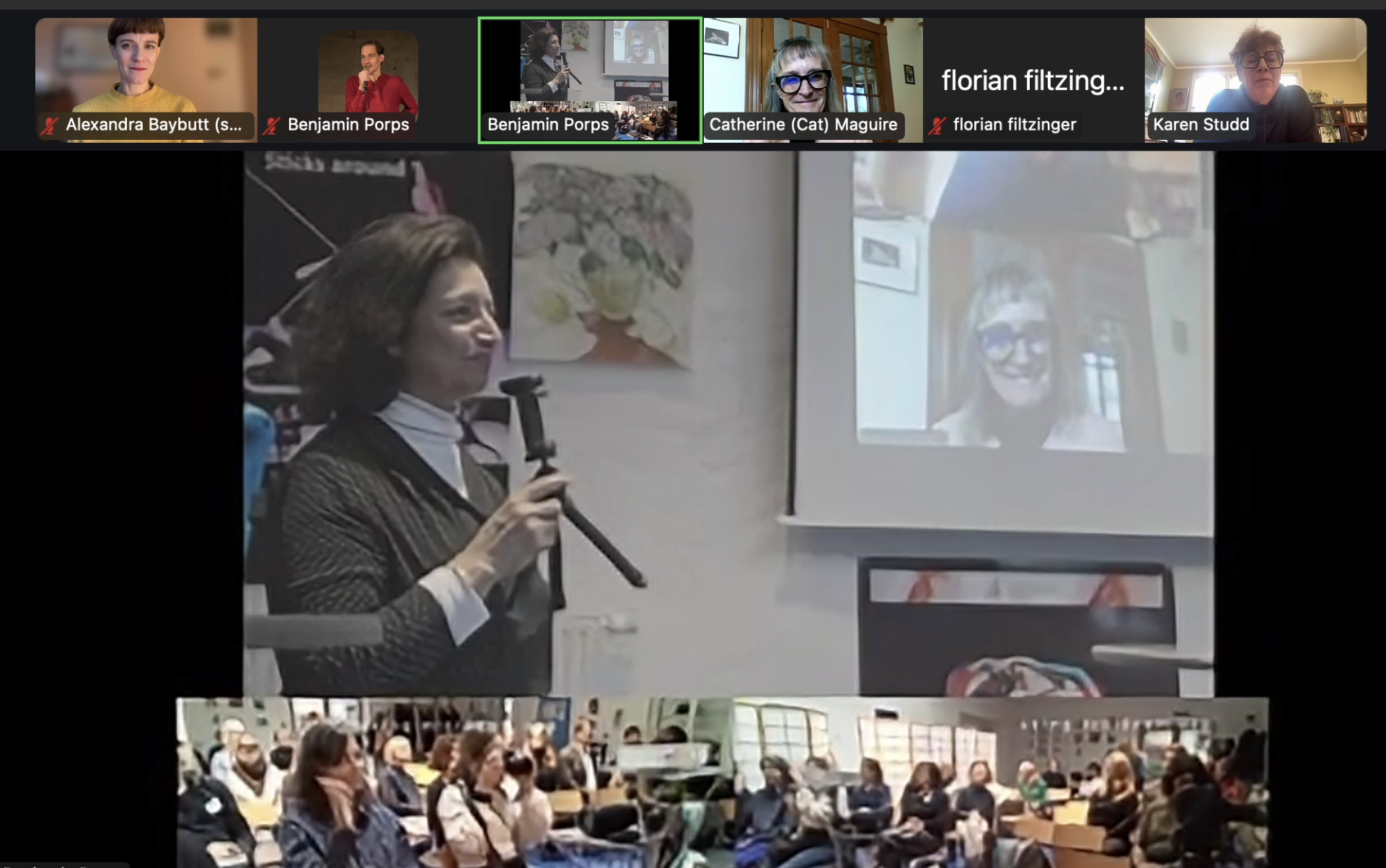
Alongside other international presenters, Karen Studd gave an online talk ‘The Developmental progression in the Laban/Bartenieff Movement System and how Change is a Constant’ in May.
Laban Situado / Laban Located was organised by Ana Patricia Farfán and Ligia Tourinho, Universidad de Las Américas Puebla.
Development and Evolution characterize life — Change is Constant
Developmental Progression is a foundational pattern that characterizes life.
Here below is what was found in a simple AI response to a google search for “the phenomenon of change”:
The phenomenon of change encompasses any observable event or transformation in the natural world, including social structures, individual behavior, and even the physical state of matter. It’s a constant and pervasive aspect of reality, affecting everything from the smallest particle to the largest galaxy. Change can be gradual or sudden, and it can be driven by a multitude of factors, such as human actions, natural processes, or even the passage of time.
Things that drive change:
Progress – Seeking improvement. Change happens because humans want to improve their condition and apply ingenuity and good problem-solving to create progress.
· Process and Product – Change both results in, as well as is driven by, increased specialization and complexity.
· Technology – Change happens because humans are motivated to solve problems, which requires the creation of new technologies, which in turn drive progress and social change.
· Conflict – there is in the duality of Change and Constant an inherent tension
· Power – this also relates to the tension in the dynamic balance of Change and Constant
· Evolution – Change happens when the physical environment changes, and organisms adapt in response to those changes.
Changes in LBMS – specifically the differentiation and explication of movement expanding the micro in service of macro understanding
Macro and Micro perspectives
· Overarching patterns – Themes are not limited to BF they can be found in all Components as well as larger patterns that are the intersections of the Components
· The system itself reveals the process of developmental progression
· The Reframing of BESS Components to B Sp Sh E
· Body – – Flowsensing and Weightsensing and the Foundation Phrase and linked to the developmental progression of Movement
· Additions to BBAs: Vocalization, Connecting, Interacting
· Space – – the Duals of the Platonic Spatial forms including explication of the Dual tetrahedrons and its relation to the Cube and the expansion of the map to include Dodecahedron
· Shape – – the foundations of Concave/Convex and Gather/Scatter in again understanding the foundation of this components and the developmental progression
· Effort – – avoiding limitations of the micro perspective understanding Effort – -the Constellation as more significant and the Phrasing as more significant to understanding the Patterns of Effort. Moving away from the overused Action Drive Model and exploring the transformation Drives – – – and seeing the process of transform as it can occur with each factor. Noting how science and all bodies of knowledge impacts how we understand Effort – – for example Space Effort and attention.
The 2025 Dance On GATHERING is an in-person and online event at Dance Exchange celebrating aging with dance, creativity, and connection
GATHER – Saturday, May 17 @ 4:00 – 5:15pm EST
Dancing Through Generations – The Role of Dancemaking and Performance in Intergenerational Collaboration
Session Fee: $15
Join us for an engaging conversation with artists Ami Dowden-Fant, Esther Geiger, Sarah Ramey, Vincent Thomas, Ken Vail, and Dance Exchange’s Executive Artistic Director, Cassie Meador, as we explore the transformative power of intergenerational dancemaking and performance. Dance Exchange has long been a leader in building community across generations through dancemaking, and in this session, we’ll hear from artists who are pushing the boundaries of this practice through their work in Creative Aging and beyond.
This session will provide an inspiring opportunity to reflect on how dancemaking and performance can be used to foster deep connections, inspire creativity, and build resilience across generations.
The panel will delve into key questions such as:
How are these artists using dancemaking and performance to build community and connection across generations?
Why do they continue to dance on and cultivate opportunities for their communities to “Dance ON” through dancemaking and performance?
What role does intergenerational exchange play in fostering a more embodied, resilient, and just world?
Join us as we discuss the joys, challenges, and impacts of dancemaking and performance in creating a space for intergenerational collaboration and community building, while considering the future of dance in fostering a more inclusive, embodied world.
Tutorial: Revealing the Meaning of Bodily Expression of Human Counterparts for Robots Using Dance Theory and Human-annotated Benchmark Datasets
Cat Maguire will lead a day long tutorial (with Amy LaViers) as part of the Arts and Robotics special track at ICRA (International Conference on Robotics and Automation) in Atlanta, USA, May 23rd, 2025 highlighting motif and notational abstractions of movement.
How do we make a machine that indicates changes to its internal state, e.g., goals, attitude, or even emotion, through changes in movement profiles?
This workshop will pose a possible direction toward such ends that leverages movement notation as a source for clearly defining abstract concepts of similarity and symbolic representation of the parts and patterns of movement – in order to identify, record and interpret patterns of human movement on both the micro and macro levels. First, we will move together. This will activate an innate ability to imitate each other and, in doing so, illuminate the principal components of Laban/Bartenieff Movement Studies and the Body, Effort, Shape, Space, and Time (BESST) System of movement analysis. Next, we will try to write down what we’re doing. A set of symbols for describing elements of the BESST System, which seem to be particularly perceptually meaningful to human observers, will be presented so that movement ideas can be notated and, thus, translated between bodies. We will explore both Labanotation and a related ”motif”-style notation. This workshop is supported by NSF award #2234196.
On December 31st 2024, WholeMovement graduated its first cohort of CWMAs, Certified WholeMovement Analysts, in Rome, Italy (in connection with Choronde Progetto Educativo). Welcome to the international community of Movement Analysts!
CWMAS / Certified WholeMovement Analysts and research project titles:
Caterina Fava: The role of Movement in my French learning process: How the Laban/Bartenieff Movement System has accompanied my personal process of learning French.
Diana Magri: Indomesticate Spaces: knowing practices for choreographic composition.
Emanuela Canton: A journey through embodiment, between conscious and unconscious images, towards self discovery and personal growth: LBMS and psychotherapy.
Francesca Cassottana: INVISIBLE SUN.
Maurizio Azzurro: Finalized to the creation of a Pedagogy For the use of masks in the Atellan Farce and in Ancient Latin Theatre.
Susanna Odevaine: ESCHER, dancing the infinity.
Vittoria La Costa: The movement of the psyche: LBMS as an observational lens and tool for reading and intertention in psychotherapy.
Matteo Vignali: Italian portraits:Through the sound of their dialects.
Camilla Crispino: Towards Lines of Embodied Becoming -The Eight Basic Action Strokes-
Chiara Parisi: Laban Bartenieff Movement System: A tool to increase and lead creative movement classes.
Ondina Cassotta: Reverse Canon – seeking new forms for ballet teaching.
Alicja Paleta: Application of LBMS in embodied emotional self-regulation – a case study.
Mara Camelin: The Ancient Art of Tai Ji Quan and the Laban-Bartenieff Movement System: A Comparison.
Maria Romana Benevento: Application of the Laban Bartenieff Movement System to Postural Gymnastics.
This program was taught by Karen Studd, Laura Cox, Cat Maguire, Alexandra Baybutt with guests tutors Lorella Rapisarda, Joanna Brotman, and Alessio Maria Romano.
The modules were supported by Caterina Mocciola as interpreter/translator in both English-to-Italian and Italian-to-English.
With deep sadness, we share the news of our colleague Laura Cox’s death (Feb 4, 2025).
Laura was one of the original founders of WholeMovement. A complex, multifaceted person interacting in the world in many capacities, Laura was a dancer, a movement educator, LBMS practitioner, Registered Somatic Movement Educator/Therapist (ISMETA), animal lover and an avid Renaissance Festival fan. Her favorite holiday was Halloween.
Students and colleagues will remember Laura for the joy and energy of her teaching and for her fierce devotion to the power of LBMS to transform people and the world we interact in.
Laura’s international presence in the LBMS community included serving as a core faculty member in two Scotland training programs as well as helping to establish the first WholeMovement training program in Rome. She co-authored (with Karen Studd) EveryBody is a Body, a guide to human movement from an LBMS perspective, which is used in training programs worldwide.
Laura was a bright and inspiring presence who has affected so many people in the movement community.
It was one of Laura’s final wishes that those who might want to honor her memory could make a donation to WholeMovement. Such donations can be made through our fiscal sponsor, Dance Box Theatre.
Mourning this sad loss to our teaching coterie and to the larger community,
Ali, Cat, Esther and Karen
For All donors:
Dance Box Theater is a nonprofit 501(c)(3) charitable organization that serves as the fiscal sponsor for WholeMovement. Your contribution to Dance Box Theater is earmarked and dedicated to WholeMovement, and is tax deductible to the fullest extent of the law.
For donors by check:
To make a contribution to WholeMovement by check, please make your donation payable to “Dance Box Theater,” with “WholeMovement” clearly noted in the memo line. Send your check to: Whole Movement, 6502 Westmoreland Avenue, Takoma Park, MD 20912.
For online donors:
To make an online contribution to WholeMovement, please visit https://danceboxtheater.org/wholemovement.html and click on the link to be directed to Dance Box Theater’s Network For Good donation page. Please enter your donation amount and enter the words “WholeMovement” in the Designation line.
Have you encountered our work before as a student, colleague, collaborator, researcher?
It doesn’t matter how long ago or how recently!
WholeMovement would be grateful for your feedback about our work.
As a thank you, we will email you the latest updated LBMS Taxonomy.
By submitting your information, you’re giving us permission to use your Testimonial on our website, in social media and any other communications, and to email you through our mailing list. You may unsubscribe at any time. You will receive an updated LBMS Taxonomy.
In WM we have been exploring the development, shaping and sharing of the Laban/Bartenieff Movement System (LBMS) Motif. We see Motif is a tool, a practice and a creative process as a part of LBMS. Engaging in it stimulates creative approaches to learning, and opens the door to further choice-making, new experiences and refined perception. The development of Motif has been occurring through faculty discussion and in the context of the classroom.
The Laban/Bartenieff Movement System (which is what we mean when we say LBMS – a whole, so not BF and LMA) is a comprehensive system used in understanding multiple aspects of human movement patterns. Its methodology incorporates a theoretical framework and language for movement including LBMS Motif, the symbolic representation of parts and patterns of movement. The system is used to identify, record and interpret both macro and micro aspects of human movement. As a system of movement analysis, LBMS is unique as it identifies and codifies both the qualitative as well as quantitative aspects of movement. To use the words of one of the Themes of LBMS, the system takes into account both Functional as well as Expressive content of actions.
WholeMovement faculty are connected to one another through a learning community model approach to teaching. We are generally present in all classes not just the ones we are teaching. We reference and build on what has occurred in other’s classes and in addition often co-teach. We engage in collective reflection on ourselves and our work, with a shared philosophical and pedagogical approach.
We use LBMS Motif in ways that have emerged from conversations around the dissatisfaction with fragmentation of educational praxis in which different parts of movement are differentiated but often not sufficiently synthesised – connected to the context of the whole. In teaching, we teach by foregrounding different parts at different times – this is of course curricular content , but always with the whole as the container in mind. In LBMS as Motif reflects the whole system, we interweave the practice of Motif throughout essentially all classes, and not a separate idea.
The incorporation of Motif addresses crucial aspects of Movement Analysis training, including choice and consensus in capturing and interpreting movement. And the Pattern of Developmental Progression of the system is built in through how we use Motif as a reflection of this pattern. Through the processes of analysis and synthesis, we acknowledge the complex nature of movement and that there is a multiplicity of meanings, unfolding in ongoing complex ways.
Motif is an idea or a way of rendering the significant essence of a concrete experience or the abstraction of an idea through image or sound or structure. Motifs are generally brief or succinct elements that represent a perceivable pattern. This is a common part of many forms of expression – notably in the visual arts as well as in literature, music etc. In other words, Motif is not an idea limited to the body of knowledge/inquiry that is movement analysis but is seen across disciplines as an expression of what is essential. Metaphor is often linked to Motif as it paradoxically links the simple to the complex through associations of concrete/literal to the abstract and the possibility of multiple and multi layered interpretations.
As many of you are probably aware, the roots of Motif go back to Kinetography Laban and has its origins in the 1930s from Laban’s work and the work of his collaborators/associates Kurt Jooss and Sigurd Leeder, developing into Labanotation, developed further by Ann Hutchinson Guest. Thus, contemporary LBMS Motif is an example of the pattern and usual progression in which an initial idea or inspiration is taken up by and added to by others in the progression of the development of all bodies of knowledge.
In contrast to Labanotation, LBMS Motif is not in any way linked to the art of recording dance for archiving and recreating, but rather deals with movement as a much broader phenomenon and applicable in all movement contexts. Recording the specificity of movement is not the primary intent of Motif in LBMS. The entanglement of Labanotation and Motif (a derivation coming from Labanotation) with dance however has been reiterated continually. The truncated version of Labanotation that has come to be identified as Motif. This idea and this version of Motif was to a large extent closely aligned with the concept of a ‘shorthand’ for capturing the dominant characteristics of movement, rather than the more micro perspective of recording all aspects of the body moving in space that Labanotation required. While Labanotation and LBMS Motif come from a similar origin, they differ in their intent and use.
LBMS Motif is a visual pictorial representation of movement essence to facilitate pattern recognition and the process of understanding possible meanings of movement.
In LBMS Motif we recognise three distinct ways of writing symbolically, Vertical, Horizontal and in Constellation. The Vertical Motif, that came from Labanotation, reveals relative duration of actions and events. Horizontal Motif reveals the order in which actions unfold (beginning, middle, end) but does not specify duration. It emerged alongside the development of Effort and later Effort/Shape theory. The Constellation Motif reveals the parts that are foregrounded in a movement event, but does not specify order, duration or sequencing. Rather, the Constellation Motif captures the parts of events and actions that are most salient to understanding the essence of what is happening. Each form of Motif Writing can be used for different purposes to reveal meanings, intent and patterns, for example seeing what is present or absent, like if there are no Effort symbols in a Constellation Motif.
Generally, the process of Motif-ing is undertaken physically using a pen or pencil and paper, though sometimes a finger on a track-pad or touch-screen is used to make these marks. Choosing in the action of drawing, whatever the medium, is understood as a significant embodiment and learning process.
In LBMS Motif, we can create a Motif and then move it to learn or explore new patterns from it. The symbols can be used as a conduit for new movement experiences rather than replication. We can also observe movement and then Motif it, practicing observation skills of discerning, differentiating, and choosing. Understanding LBMS Motif as a technique is not to argue that it must be practiced in a specific way. Rather, the more facility you have with the symbols and how you explore meaning-making with them, the more possibilities are made available for movement experience, and observation or perception skills. LBMS involves processes of coming to consensus and the versatility of LBMS Motif communicates both outwards with others and inwards to your own understanding.
It is problematic that sometimes LBMS Motif is referred to as a ‘short-hand’ of Labanotation, or the ‘highlights’ of movement. ‘Highlight’ does not imply pattern or progression. Rather it isolates and edits, much like a still image of a photograph, which is not a helpful way of describing movement and change. Distillation of essence does not necessarily mean being as brief as possible. Becoming more specific does not necessarily mean becoming more micro (for example, the left little finger of the hand vs the larger macro idea of a distal body part). ‘Short-hand’ does hint at brevity and a process of contraction, but it is more appropriate to understand LBMS Motif as an expression of the whole system of LBMS itself. It is clear that LBMS Motif operates under different terms and procedures than Labannotation, as well as having different symbols. The different symbols, some of which we will share here, can refer to micro details whilst others designate broader concepts. The following list is the way in which we articulate LBMS Motif for students in our training programs.
LBMS Motif contributes to the process of the part/whole thematic duality of analysis and synthesis. Patterns are not individual parts but phrases of parts in relationship, understood as whole in themselves. Whilst Body, Space, Shape and Effort are used to subdivide or categorise movement phenomena, there are three other overarching, or macro patterns LBMS uses: 1. Developmental Progression, 2. Thematic Duality and 3. Phrasing.
These have specific, micro usages, as well as referring to larger macro patterns. In relation to today’s subject of Motif I want to start by addressing the Pattern of Thematic Duality
Symbols for the Thematic Dualities have emerged through a particular story. Starting quite a long time ago in a discussion led by Antja Kennedy symbols were proposed for the Themes.
However The Laban/Bartenieff community internationally had no formal process to come to consensus to use or not. But a PDF was shared amongst colleagues. Karen began sharing this particular PDF citing its source and saying that it was “unofficial”. It was met with great enthusiasm in part due to an emphasis on the large idea of Patterns that we were emphasising in support of synthesis. These particular symbols have repeatedly shown their usefulness and appropriateness and are part of the LBMS taxonomy that we use in all our trainings. And in this vein, we are constantly encouraging students to develop symbols that meet their own needs in their particular application as part of a creative practice and need. As co-founder of WholeMovement Laura Cox always liked to tell students, there are no Motif police.
The Forward and Backwards symbols in Labanotation have been used in Laban-based trainings as part of dance education at conservatoires, as well as in movement analysis programmes such as LBMS and Language Of Dance. For those students who had not encountered Labanotation, and even for those who had, the symbol provoked confusion because of the symbol having the ‘chimney’ on the right or left side. This is historically connected to the notation system for bipedal weight support and transfer activity. The ‘chimney’ implies and conflates Body and Space. But the spatial notion is Forwards, irrespective of right or left sidedness, and so a modification to the symbol was adopted to eliminate the detail of right or left Body basis built into the old symbol. Whilst also assuaging the confusion of right or left when it does not matter to the movement experience or phenomena, this new symbol attempts to illuminate a shared notion of forward or backward that includes more bases of support other than the bipedal assumption in the Labanotation symbol. Forward is forward in the Sagittal space whether you are on two legs, a leg and a crutch, a wheelchair, and so forth. The symbol alludes to a commonality of the shared spatial phenomenon of forward/backward, rather than subtly reiterating and reinforcing a normative, ableist body expectation of human anatomy and locomotion.
Studd and Cox (2019: 150) added ‘vocalizing’ to the list of Basic Body Actions to explicate voice as an action. Whilst LMBS supports understanding non-verbal communication, the use of voice as a continuum from breath, sound, word, and sentence is a vital, foundational part of human experience, interaction and movement. The symbol acts not only to include voice, but to argue it as a kinaesthetic, kinetic phenomenon. Expertise from fields of music, drama, literature, linguistics and philosophy exists to offer immense specificity about how voice might be used and its effects. In LBMS there is no one particular way voice should be used, but rather the system can be explored to identify or support vocalization based on the context or situation, for example, communication or movement re-patterning, not forgetting the working languages, values and aims in that specific time and place. The inclusion of voice within the LBMS taxonomy explicates as well as integrates an understanding of movement that does not ignore vocalization. Including voice as movement recognises complex relations between voice and communication, and the addition of this symbol reflects how LBMS attempts to explore wholeness through different strategies. This update and addition to the Basic Body Actions symbols makes something implicit explicit.
Likewise, it became important to differentiate and identify how a mover’s experience occurs in a context and environment. The focus of the locus of control on the mover and identifying solo movement experience that Somatic practices tend to focus on the actions of an individual and repatterning them, mover regardless of context, whereas context is always a crucial aspect of what we are looking at, in which repatterning might not be the aim or only possibility. This symbol allows reflection upon the whole of a context, not only a part. Again the update to BBAs supports what was implicit to be explicit. We have also added a symbol for Interaction – which moves beyond the solo mover and allows to recognize the mover in the larger context of environment. This symbol references the action of connecting with two action strokes.
The Innersphere symbol, and the concept of Innersphere, recognises Inner Space which unlike the specificity of Kinesphere was not explicated in the literature historically. Experience of ‘inner’ was primarily relegated to the Body Component through Breath experience (often through a process of Dimensional Breathing), but not articulated as a spatial phenomenon. The concept of Innerspere becomes foundational to a Body/Space duality in which Space can be understood as a continuum including the mover – from inner space to Kinespheric Space to General Space, and where Space can be both the content and container of human movement within in, around or outside the body. The Innersphere symbol helps to make explicit the spatial continuum of the human movement experience. Whilst this talk focuses on Motif, the large idea of Space Harmony is foundational to understanding LBMS as a theory, practice and intervention. Space Harmony in LBMS is premised on the Body/Space duality and wholeness of the development of self/other. The human capacity for abstract thought and symbolic representation grows out of the foundational Body/Space experience and continuum. The development of symbols that help recognise and articulate experience are a significant part of this process. Hence we understand BESS in ways that are not so equivalent as the acronym suggests.
We use Motif to bridge ways of thinking, moving and learning for meaning-making and recognition. It helps to develop a shared language, which is important generally but especially in cross-cultural classrooms in which Motif continually reminds us that language is a lived and living context. We have found that both the learning and facilitation of LBMS Motif transforms our teaching and perceptual habits, and challenges our students to do the same. Teaching and using Motif in different parts of somatic movement education and observation training produces conditions for new modes of perception to arise through experience, observation and interaction. Grappling with the problems of fragmentation in learning – both for the individual student and broader community that this conference helps to overcome – we argue that LBMS Motif can be an integrative tool for bringing to consciousness habits and patterns of thought and action. Using it as an intervention to repattern the system, and the ways it is taught and learnt, continues to open the door for further choices and engagement with other bodies of knowledge.
Language evolves and develops organically, playfully and out of necessity. Indeed, emojis and text-speak reflect choice, brevity and consensus. We are constantly encouraging students to develop symbols that meet their own needs and in their particular application, as part of a creative practice and communicative intent. As WholeMovement co-founder Laura Cox always liked to tell students, there are no Motif police.
If creativity involves myriad processes of curiosity, generation of ideas and the will to produce and share with others, LBMS Motif shows enduring creative potential for explicating awareness and perception. Engaging in LBMS Motif as a tool, a practice and a creative process stimulates new approaches to learning, and supports making choices, whilst opening to new experiences, both individually and together.